

12.6K
Downloads
230
Episodes
From Wall Street’s opening bell to market close.
Episodes

13 hours ago
13 hours ago
19 min
AINewsWire Editorial Coverage: The artificial intelligence industry is racing to build computing capacity. But a new constraint is emerging just as quickly: electricity. The International Energy Agency projects that global data-center electricity demand will keep climbing sharply through 2030. Goldman Sachs forecasts roughly 15% compound annual growth in U.S. data-center power demand from 2023 through 2030, with data centers potentially accounting for approximately 8% of total U.S. electricity use by then. That widening gap between AI’s appetite for compute and the grid’s ability to deliver power is reshaping how, and where, AI infrastructure gets built. It is precisely the opportunity AZIO AI Holdings Inc. (NASDAQ: AZIO) (Profile) is pursuing through its power-backed compute campuses, including its south Texas project, Atlas One. The company has now taken a concrete step in that direction, signing its first hosting agreement at Atlas One with Power Champion Investment Limited, covering an initial 10 megawatts of capacity with expansion rights up to 50 megawatts. That agreement gives Atlas One its first contracted, paying customer and positions AZIO AI with other leading technology and infrastructure providers whose products and services form the backbone of the global AI buildout, including NVIDIA Corporation (NASDAQ: NVDA), Microsoft Corporation (NASDAQ: MSFT), Amazon.com Inc. (NASDAQ: AMZN) and Alphabet Inc. (NASDAQ: GOOGL).
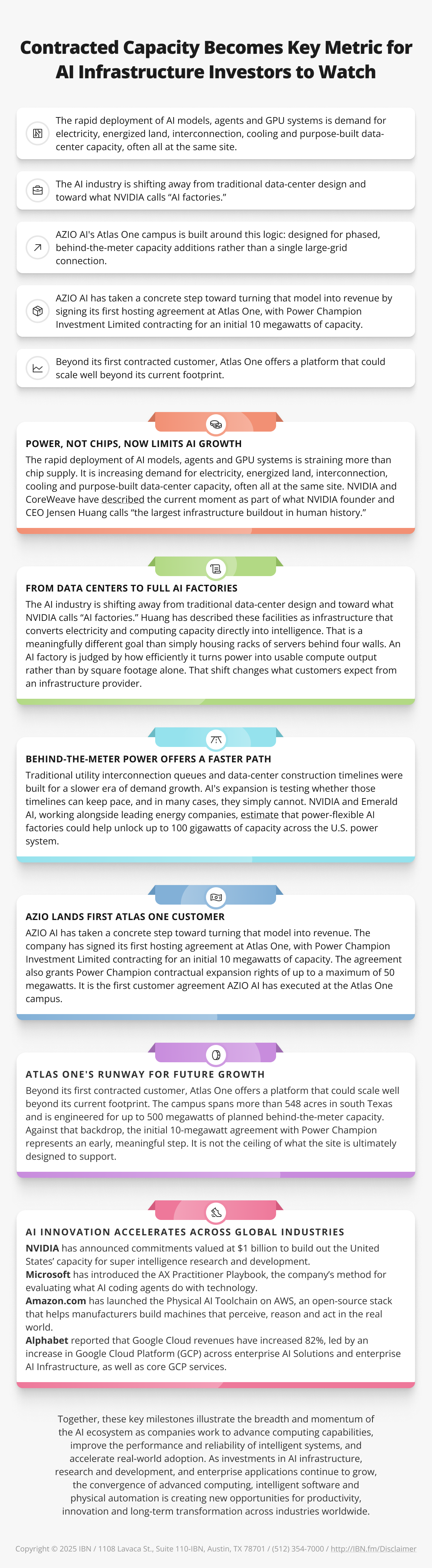
- The rapid deployment of AI models, agents and GPU systems is demand for electricity, energized land, interconnection, cooling and purpose-built data-center capacity, often all at the same site.
- The AI industry is shifting away from traditional data-center design and toward what NVIDIA calls “AI factories.”
- AZIO AI’s Atlas One campus is built around this logic: designed for phased, behind-the-meter capacity additions rather than a single large-grid connection.
- AZIO AI has taken a concrete step toward turning that model into revenue by signing its first hosting agreement at Atlas One, with Power Champion Investment Limited contracting for an initial 10 megawatts of capacity.
- Beyond its first contracted customer, Atlas One offers a platform that could scale well beyond its current footprint.
To view the full Publication, visit https://ibn.fm/kgvBq
For further information about AZIO Holdings, please visit the AZIO Holdings profile.
https://ainewswire.com/ai-companies/azio-ai-holdings-inc/
To receive SMS alerts from AINewsWire, text “AI” to 888-902-4192 (U.S. Mobile Phones Only)
For more information, please visit www.AINewsWire.com
IBN, a multifaceted communications organization engaged in connecting public companies to the investment community, is pleased to announce the release of the latest episode of The Bell2Bell Podcast as part of its sustained effort to provide specialized content distribution via widespread syndication channels.
The Bell2Bell Podcast delivers informative updates and exclusive interviews with executives operating in fast-moving industries. The Bell2Bell Podcast’s latest episode features Galiano Tiramani, Co-Founder and Co-CEO of BOXABL Inc. (NASDAQ: BXBL), an innovative technology company transforming the housing market with its modular building systems.
To begin the interview, Tiramani provided an overview of BOXABL’s approach to housing construction, highlighting the company’s goal of applying assembly-line mass production to an industry that continues to rely heavily on traditional on-site building methods.
“Our company is called BOXABL, and we are building houses in a factory. Our goal is to fix housing by dramatically lowering the cost,” Tiramani said. “We think we can achieve that by just building houses on an assembly line with mass production, the way all other modern products are built since the Industrial Revolution. There’s a huge opportunity in housing to bring this product category onto the assembly line.”
Tiramani then explained how BOXABL’s modular building system is designed to address one of the fundamental obstacles that has historically limited factory-built housing: efficiently transporting large structures from a centralized manufacturing facility to building sites.
“What we’re building is a replacement for traditional site construction, so we build to the regular residential building code,” he said. “The big innovation that we started with was fixing shipping because, of course, houses are very big, so they don’t fit on the road. That’s the reason they’re not built in a factory. Our first solution was, let’s fix that shipping so that we can get these things anywhere in the country without it being cost prohibitive. That means that we can actually have a big factory because we have a big shipping radius, and a big factory means mass production. It means economies of scale, and that’s how we’re going to be able to crush the cost.”
For more information, visit the company’s website at www.BOXABL.com
To hear the episode and subscribe for future podcasts, visit https://podcast.bell2bell.com
For more information, please visit https://www.IBN.Ai
Please see full terms of use and disclaimers on the InvestorBrandNetwork website applicable to all content provided by IBN, wherever published or re-published: http://IBN.fm/Disclaimer